The European Union Delegation in Montenegro, in collaboration with ŽPCG, organised a symbolic train journey from Podgorica to Bijelo Polje on 4 December.
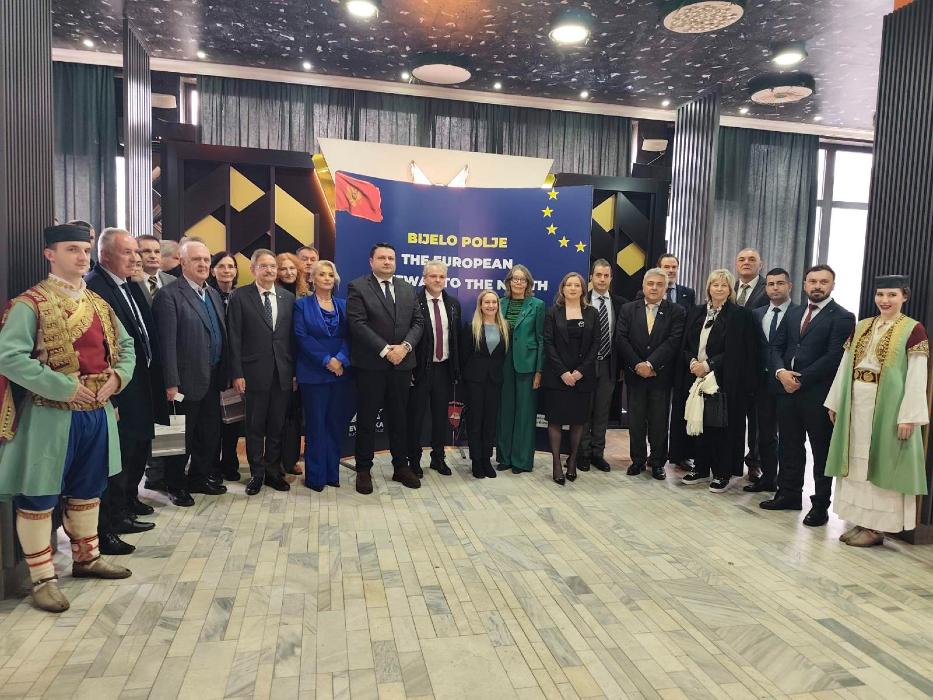
The European Union Delegation in Montenegro, in cooperation with the Railway Transport of Montenegro (ŽPCG), organised a symbolic train journey from Podgorica to Bijelo Polje on 4 December to mark the ceremonial opening of the European House in Bijelo Polje – the third centre of its kind in the country, aimed at strengthening communication, informing, and connecting citizens with European values, policies, and programmes.
The programme commenced at the Main Railway Station in Podgorica, where statements were given to the media by the Head of the European Union Delegation in Montenegro, Ambassador Johan Satler, the Deputy Prime Minister for Infrastructure and Regional Development Milun Zogović, and the Executive Director of Railway Transport of Montenegro, Dragana Lukšić.
The Executive Director of ŽPCG, Dragana Lukšić, emphasised that today’s journey best illustrates the role of the railway as the greenest and safest mode of transport, fully aligned with European green agenda goals. “This journey has a special symbolic significance – as it connects Montenegro and the European Union not only by rail but also through shared values: ecology, sustainability, and green transport, reminding us how important it is to preserve nature and the resources around us. One electric train can transport hundreds of passengers, replace dozens of cars, thereby reducing carbon dioxide emissions and energy consumption, but equally importantly – connect people and communities in a sustainable way,” stated Lukšić, highlighting that in the previous period, Railway Transport of Montenegro has implemented a series of activities aimed at modernising the fleet and improving service quality.
She added that the support of the European Union is crucial for the continued modernisation of the railway system. “In recent years, with strong support from the European Union, the European Bank for Reconstruction and Development, and other European financial institutions and the Ministry of Transport, Railway Transport of Montenegro has secured funds for the procurement of new rolling stock and the modernisation of the existing fleet, which are concrete steps showing that we are working together towards a modern and green railway future,” emphasised Lukšić.
“Our goal is clear – to increase the quality, reliability, and accessibility of railway transport, thus offering a suitable alternative to road transport. Therefore, let today’s journey be a symbol of our shared path – a path on which Montenegro moves forward, side by side with Europe, preserving what makes us special: our nature, our people, and our commitment to sustainable mobility,” concluded Lukšić.
The Ambassador of the European Union in Montenegro, Johan Satler, reminded that the EU invested 30 million euros in the modernisation of railway infrastructure over the past year, enabling significant improvements in safety and travel speed. Satler also announced a new investment package worth 300 million euros, of which 150 million euros is non-repayable assistance from the citizens of the European Union, while the remaining part will be provided through favourable loans from European development institutions. “Trains will no longer travel at 20 kilometres per hour, but at 80 kilometres per hour – that is the concrete result of European support,” stated Ambassador Satler, thanking Railway Transport of Montenegro for the successful cooperation in the implementation of this project.
The Deputy Prime Minister of Montenegro, Milun Zogović, stated that today’s journey carries strong symbolism as it demonstrates the state’s commitment to the development of the north and balanced regional development. “Of the announced 300 million euros in investments, 220 million will be directed towards the reconstruction of the Golubovci–Bar section, while the remainder will be used for the renovation of bridges up to Bioča. This railway line is not only a transport route but also an economic corridor. By reconstructing the entire railway, the Port of Bar will also be fully operational. The opening of the European House in Bijelo Polje confirms that together with our European partners, we are building the infrastructure, institutions, and values that will bring a better and safer life to citizens,” stated Zogović.
Accompanied by the EU ambassador, representatives of ministries, the diplomatic corps, and the media, the train branded with messages from the national ecological campaign “Protect to be Protected” headed north, carrying a strong symbolism of connection, sustainability, and Montenegro’s European path. During the two-hour journey, guests had the opportunity to enjoy the unique landscapes of the Morača and Tara canyons, crossing bridges and tunnels that testify to the exceptional engineering feat of constructing the Bar–Belgrade railway.
The journey of the European Union delegation and Railway Transport of Montenegro from Podgorica to Bijelo Polje once again confirmed that the railway remains a symbol of connection, sustainable development, and Montenegro’s European path – as well as that cooperation with European partners will continue to strengthen the capacities of the domestic railway system towards modern, safe, and environmentally responsible transport.